
In short: Consulting slides follow three principles. The Pyramid Principle puts the answer first, then the arguments that support it. Action titles state each slide's message in a full sentence, so the titles alone tell the story. MECE splits problems and options into parts that don't overlap and leave nothing out. Each slide carries one message, proven by what is below the title.
Consulting decks are easy to recognise: every slide makes one point, the titles read like a story, and the charts prove exactly what the title claims. That is not a design style you can copy with fonts and colours. It comes from a small set of principles about structure, and a few design rules that follow from them.
The anatomy of a consulting slide
Almost every consulting slide has the same five parts, always in the same place:
- Tracker: a small label at the top that shows where you are in the deck, such as “Executive summary” or “Performance”.
- Action title: the message of the slide in one or two lines.
- Body: the evidence for the title, as a chart, table or framework.
- Source and footnotes: where the numbers come from, at the bottom.
- Page number: so people can refer to the slide in discussion.
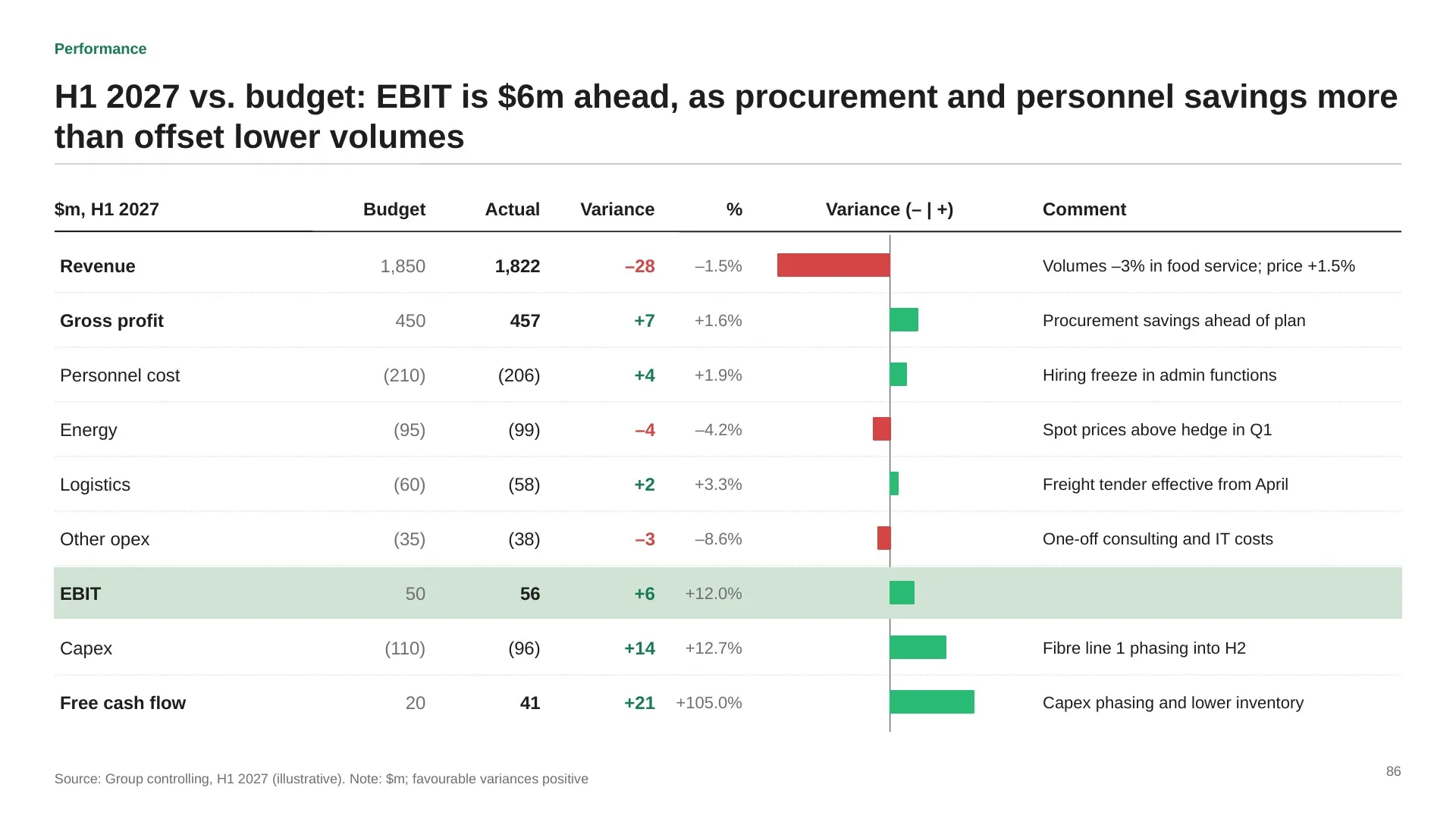
The fixed positions matter more than they seem. When every slide is built the same way, readers stop looking for things and start reading the content.
Principle 1: The Pyramid Principle
Start with the answer. The Pyramid Principle, developed by Barbara Minto, is the backbone of consulting communication. You lead with the governing thought, the one message you want the audience to take away. Below it come three or so arguments that support it, and below each argument the evidence.

It works on two levels:
- For the deck: the executive summary comes first and contains the answer. The rest of the deck is the evidence, in the order of the arguments.
- For each slide: the title is the answer, and the body supports it.
To open a deck or an executive summary, many consultants use situation, complication, resolution: what is true today, what has changed or gone wrong, and what you recommend. It leads the audience to the answer in three sentences.
Principle 2: Action titles
Every title states the message, not the topic. “EBIT bridge 2025 to 2030” names a chart. “Identified initiatives close about 80% of the gap to the 2030 ambition: $60m remains to be sourced” tells the reader what the chart shows and why it matters.

Good action titles are full sentences, specific and quantified where possible, and no longer than two lines. Two tests keep them honest:
- Horizontal logic: read only the titles of the deck, one after the other. They should tell the complete story without the slides.
- Vertical logic: on each slide, everything below the title should prove the title, and nothing else. A chart that shows more than the title claims is a distraction; a title that claims more than the chart shows is a risk.
Principle 3: MECE
Break things down without gaps or overlaps. MECE stands for mutually exclusive, collectively exhaustive. Whenever you split a problem, a set of options or a list of reasons, each part should be distinct from the others, and together they should cover everything.

The decision tree above is a typical example. The three options, a joint venture, an acquisition and doing nothing, don’t overlap, and together they cover the real choices. Leaving out “do nothing” would make the comparison incomplete, because it is the baseline every option has to beat.
MECE also keeps groupings short. Three to five items per level are easy to follow; more than that usually means two levels have been mixed.
Design rules that follow from the principles
- One message per slide. If a slide needs two titles, it needs to be two slides.
- Choose the chart for the message. A bridge shows what changed, a bar chart compares, a line shows a trend, a table gives exact values.
- Use colour to point, not to decorate. Keep most elements neutral and highlight only what the title talks about.
- Keep the grid fixed. Titles, charts and sources in the same position on every slide, with the same fonts and sizes.
- Show units and sources. Every number needs its unit, and every chart a source line.
The principles at a glance
| Principle | What it means | Quick test |
|---|---|---|
| Pyramid Principle | Answer first, then the arguments, then the evidence | Does the executive summary contain the answer? |
| Action titles | Each title states the slide’s message in a full sentence | Do the titles alone tell the story? |
| Vertical logic | Everything on a slide proves its title | Does anything on the slide go beyond the title? |
| MECE | Breakdowns without overlaps or gaps | Is any part counted twice, or missing? |
| One message per slide | One title, one point | Could you split the slide in two? |
A worked example: a deck you can read from the titles
The slides above come from Project Evergreen, the worked example in the Demo edition of the Consulting Slide Toolkit: a growth strategy for a packaging company. Read only some of its titles in order, and the story is already there:
- We should become the focused leader because the market rewards it, we can win and it pays back.
- Identified initiatives close about 80% of the gap to the 2030 ambition: $60m remains to be sourced.
- Growth flywheel: sustainable product leadership wins accounts, fills plants and funds the next round of innovation.
- The joint venture has the highest expected value ($165m) and avoids the downside of an acquisition.
- Three decisions are required from the Steering Committee today.
The first title is the governing thought of the pyramid. The next ones are the arguments and the decision that follows. Each slide body then proves its title: the bridge proves the gap, the decision tree proves the choice.
Common mistakes
- Building up to the answer. Consulting decks state the conclusion first; a slow build-up loses senior readers by slide three.
- Topic titles. “Market overview” tells the reader nothing about what to think.
- Charts that show everything. If the title is about one segment, highlight that segment and grey out the rest.
- Overlapping lists. “Cost, efficiency and processes” mixes levels; the reader can’t tell what is counted where.
- Inconsistent layouts. Titles and charts that move from slide to slide make a deck feel stitched together.
Get the slides ready-made
The Consulting Slide Toolkit is built on these principles: 170 slides with action titles, trackers and source lines, 7 ready-made storylines for common consulting documents, and Project Evergreen as a complete worked example.
Questions
What is the Pyramid Principle?
A way of structuring communication developed by Barbara Minto. You start with the main message, the governing thought, then give the few arguments that support it, and below each argument the evidence. Readers get the answer first and can stop at the level of detail they need.
What does MECE mean?
Mutually exclusive, collectively exhaustive. The parts of a breakdown don't overlap, and together they cover everything. It applies to issue trees, lists of options, groupings of arguments and the segments of a chart.
What is an action title?
A slide title that states the message of the slide in a full sentence, such as “Costs rose 8%, driven by energy”, instead of naming the topic, such as “Cost development”.
How long should an action title be?
One or two lines, about 15 words at most. If you need more, the slide probably has more than one message and should be split.
About slidefind: PowerPoint toolkits created and hand-picked by experts. Developed with professionals from consulting, finance, start-ups and academia.